
By Dr. Wade Baskin, DPT
Thanksgiving kicks off my favorite stretch of the year. It’s a season for gratitude, for family, for faith, and yes, for food. Between Thanksgiving dinner, church potlucks, office parties, and Christmas, most of us will sit down to more big meals in the next six weeks than in any other part of the year.
I’m not here to talk you out of the sweet potato casserole. I’m here to help you enjoy it and still feel good afterward.
First, my honest take on carbs
Carbohydrates are not essential. That’s not just my opinion. The Institute of Medicine’s own nutrition reference report states that “the lower limit of dietary carbohydrate compatible with life apparently is zero, provided that adequate amounts of protein and fat are consumed” (Institute of Medicine, 2005).
But let’s be real. Carbs are always going to be part of our lives, especially around a holiday table. Rolls, dressing, mashed potatoes, pie. So instead of pretending otherwise, let’s handle them wisely.
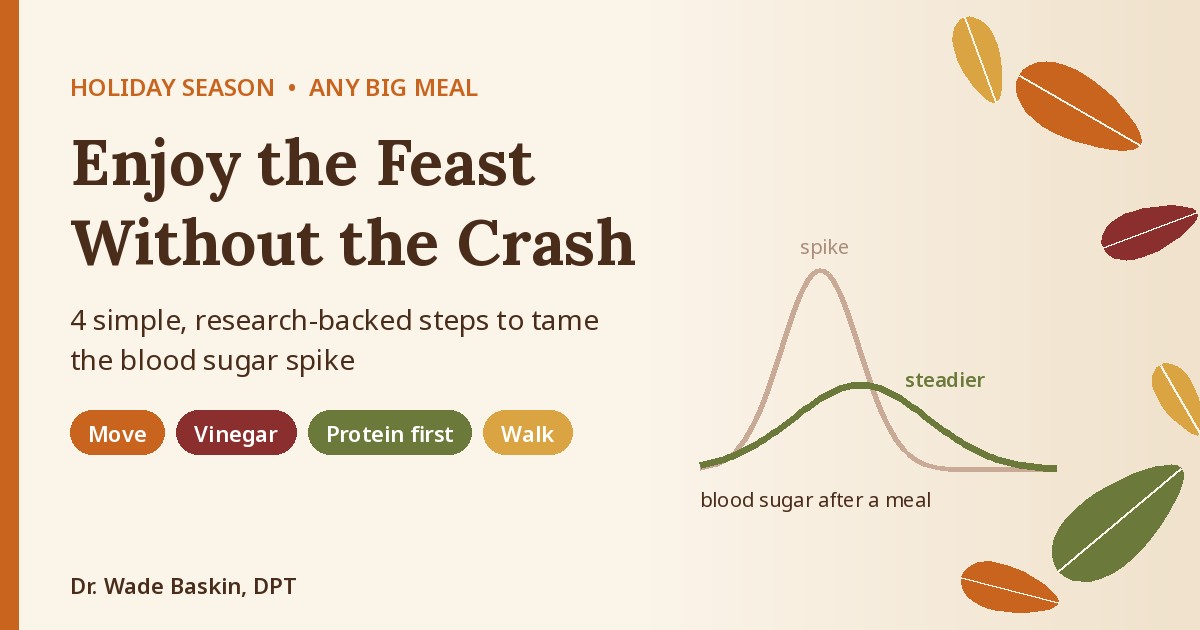
Here’s the idea in plain terms. When you eat a plate heavy in starch and sugar, your blood sugar climbs fast, and your body releases insulin to bring it back down. The bigger and faster that rise, the more work your body has to do. The four steps below are about flattening that curve. None of them require skipping a single dish.
1. Move a little before you eat
Your muscles are the biggest “parking lot” for sugar after a meal. When a muscle contracts, it moves glucose transporters called GLUT4 up to the cell surface and pulls sugar out of your bloodstream (Richter & Hargreaves, 2013). Think of it as opening extra doors for sugar to leave the blood and go where it’s useful.
Researchers have tested this with what they call “exercise snacks”: six one-minute bursts of exercise about 30 minutes before meals. In adults with insulin resistance, those short bursts lowered blood sugar after breakfast and dinner, lowered 24-hour average glucose, and a version that mixed walking with resistance moves worked just as well (Francois et al., 2014).
How to do it:
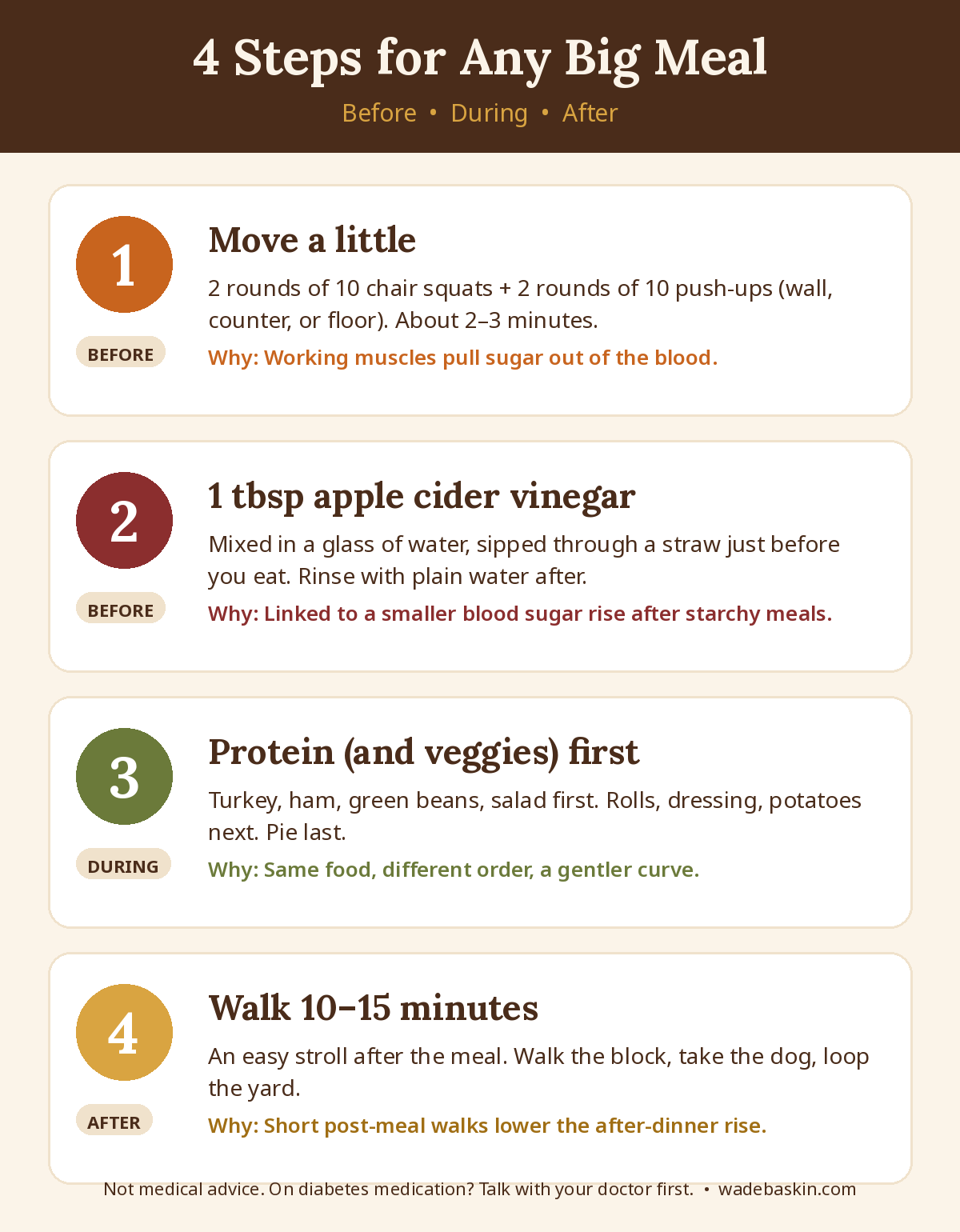
- 2 rounds of 10 chair squats: stand up from a sturdy chair and sit back down. Use the armrests if you need to.
- 2 rounds of 10 push-ups: against a wall or kitchen counter, or on the floor if you’re up for it.
- That’s two or three minutes. Do it while the turkey rests, and invite the grandkids to join you.
2. A tablespoon of apple cider vinegar before the meal
Vinegar has been studied for decades, and the active ingredient appears to be acetic acid. One study found vinegar slowed how quickly the stomach emptied after a starchy meal, which spreads the sugar out over time (Liljeberg & Björck, 1998).
The numbers are encouraging. In small controlled studies, adding vinegar to a meal with white bread lowered the blood sugar response by roughly 30 to 35 percent (Brighenti et al., 1995; Liljeberg & Björck, 1998), and more vinegar meant a bigger effect and a fuller feeling (Östman et al., 2005). A 2017 review that pooled the clinical trials found vinegar significantly reduced both blood sugar and insulin after meals (Shishehbor et al., 2017). Results vary from person to person and meal to meal, so think of it as a helpful nudge, not magic.
How to do it:
- Mix 1 tablespoon of apple cider vinegar into a glass of water and drink it just before you eat.
- Sip it through a straw and rinse your mouth with plain water afterward. Vinegar is acidic enough to wear on tooth enamel (Willershausen et al., 2014).
- Skip the vinegar pills. Apple cider vinegar tablets have been linked to throat injury, and products vary widely in what’s actually in them (Hill et al., 2005).
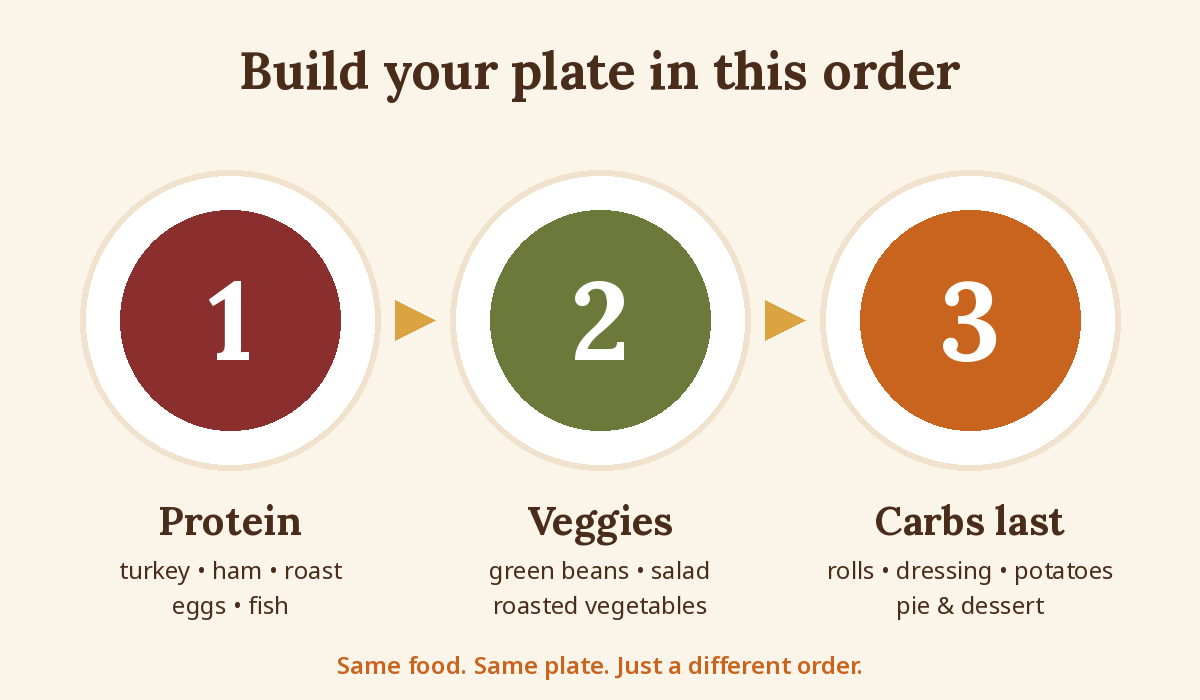
3. Eat the protein first (and the veggies), carbs last
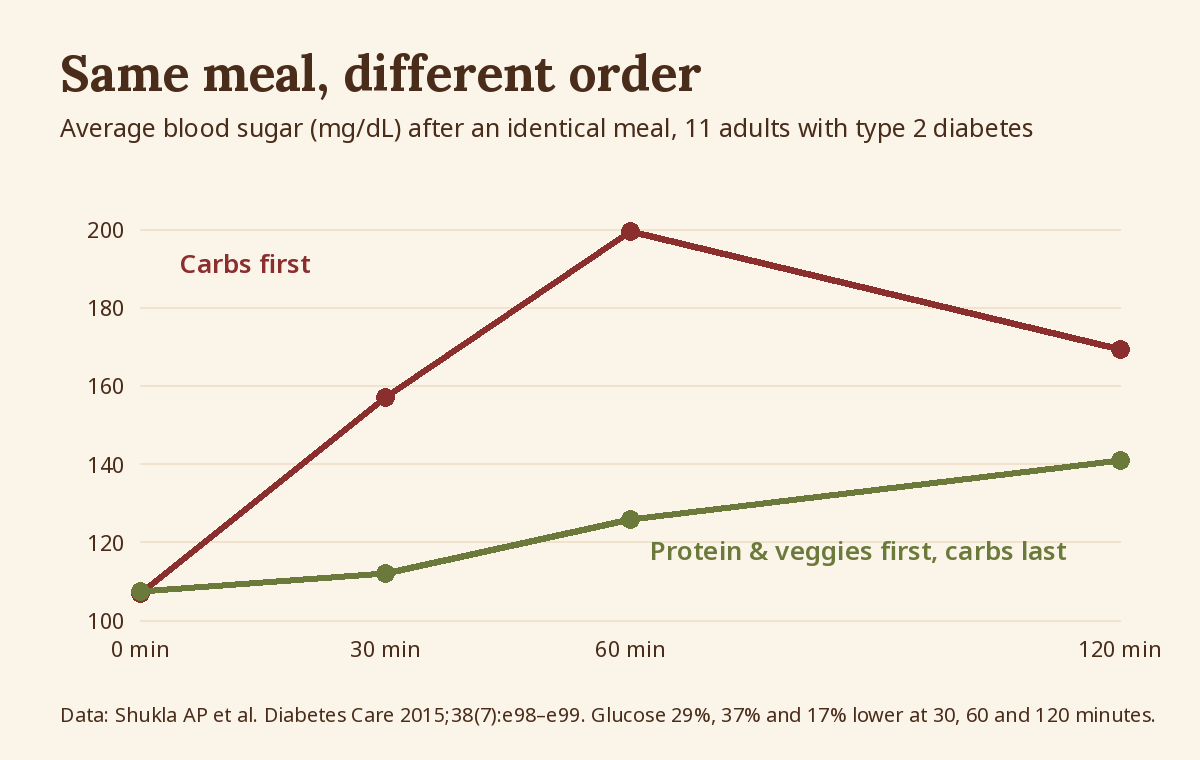
This one costs nothing and takes no extra time. In a study from Weill Cornell, adults with type 2 diabetes ate the exact same meal on two different days. One day they ate the bread and juice first. The other day they ate the chicken and vegetables first and the carbs 15 minutes later. When the carbs came last, blood sugar was about 29, 37, and 17 percent lower at 30, 60, and 120 minutes, and insulin was lower too (Shukla et al., 2015).
A follow-up study found that saving carbs for last cut the blood sugar peak roughly in half compared with eating carbs first (Shukla et al., 2017).
At the holiday table:
- Start with the turkey, ham, green beans, and salad.
- Then enjoy the dressing, rolls, and potatoes.
- Pie comes last, which is where it belongs anyway.
4. Walk after the meal
This is the easiest step to share with the whole family. A review that combined seven trials found that breaking up sitting with light walking significantly lowered both blood sugar and insulin after eating, and walking beat simply standing up (Buffey et al., 2022).
Timing matters, too. In older adults at risk for blood sugar problems, three 15-minute walks after meals did a better job of lowering the after-dinner rise than one 45-minute walk at another time of day (DiPietro et al., 2013). And in adults with type 2 diabetes, a 10-minute walk after each meal beat a single 30-minute daily walk, with blood sugar after the evening meal about 22 percent lower (Reynolds et al., 2016).
How to do it:
- 10 to 15 minutes at an easy pace. You don’t need to break a sweat.
- Walk the block with family, take the dog out, or just loop the yard.
- It’s a great time to catch up with the people you love and count your blessings.
Putting it all together
- Before: 2–3 minutes of chair squats and push-ups, then your vinegar water.
- During: protein and veggies first, carbs last.
- After: a 10- to 15-minute walk.
This isn’t just a Thanksgiving trick. Use it at Christmas dinner, Sunday lunch, a birthday party, or any meal where you know the carbs are coming.
A few words of caution
- If you take diabetes medication or insulin, talk with your doctor before trying these steps. They’re designed to lower your blood sugar, and combining them with medication could change how you respond.
- Vinegar isn’t for everyone. Skip it if you have reflux, ulcers, stomach problems, or trouble swallowing. Always dilute it.
- Move within your limits. Use a sturdy chair and wall push-ups if your knees, shoulders, or balance need it. Stop if anything causes pain, chest discomfort, or dizziness.
This article is for general education and isn’t medical advice. Talk with your own doctor or healthcare provider before changing your diet, exercise, or medications.
Give thanks, and enjoy the table
I’m grateful for every one of you who reads these posts. This season, enjoy the people around your table, savor the food, and take care of the body you’ve been given. A little movement, a little vinegar, a smarter plate order, and a walk afterward go a long way.
About Dr. Wade Baskin, DPT
Dr. Wade Baskin is a physical therapist at FYZICAL Louisville. If something is keeping you from doing those squats or that after-dinner walk, like a cranky knee, a stiff back, or balance you don’t trust, we offer a free screen. CALL 662-773-3700 or visit gtpt.net.
Catch Fyzical Friday on The Refuge 107.1.
References
- Institute of Medicine. Dietary Reference Intakes for Energy, Carbohydrate, Fiber, Fat, Fatty Acids, Cholesterol, Protein, and Amino Acids. Chapter 6: Dietary Carbohydrates: Sugars and Starches. Washington, DC: National Academies Press; 2005. https://nap.nationalacademies.org/read/10490/chapter/8
- Richter EA, Hargreaves M. Exercise, GLUT4, and skeletal muscle glucose uptake. Physiol Rev. 2013;93(3):993-1017. https://pubmed.ncbi.nlm.nih.gov/23899560/
- Francois ME, et al. ‘Exercise snacks’ before meals: a novel strategy to improve glycaemic control in individuals with insulin resistance. Diabetologia. 2014;57(7):1437-45. https://pubmed.ncbi.nlm.nih.gov/24817675/
- Liljeberg H, Björck I. Delayed gastric emptying rate may explain improved glycaemia in healthy subjects to a starchy meal with added vinegar. Eur J Clin Nutr. 1998;52(5):368-71. https://pubmed.ncbi.nlm.nih.gov/9630389/
- Brighenti F, et al. Effect of neutralized and native vinegar on blood glucose and acetate responses to a mixed meal in healthy subjects. Eur J Clin Nutr. 1995;49(4):242-7. https://pubmed.ncbi.nlm.nih.gov/7796781/
- Östman E, et al. Vinegar supplementation lowers glucose and insulin responses and increases satiety after a bread meal in healthy subjects. Eur J Clin Nutr. 2005;59(9):983-8. https://pubmed.ncbi.nlm.nih.gov/16015276/
- Shishehbor F, Mansoori A, Shirani F. Vinegar consumption can attenuate postprandial glucose and insulin responses; a systematic review and meta-analysis of clinical trials. Diabetes Res Clin Pract. 2017;127:1-9. https://pubmed.ncbi.nlm.nih.gov/28292654/
- Willershausen I, et al. In vitro study on dental erosion caused by different vinegar varieties using an electron microprobe. Clin Lab. 2014;60(5):783-90. https://pubmed.ncbi.nlm.nih.gov/24839821/
- Hill LL, et al. Esophageal injury by apple cider vinegar tablets and subsequent evaluation of products. J Am Diet Assoc. 2005;105(7):1141-4. https://pubmed.ncbi.nlm.nih.gov/15983536/
- Shukla AP, et al. Food order has a significant impact on postprandial glucose and insulin levels. Diabetes Care. 2015;38(7):e98-9. https://pubmed.ncbi.nlm.nih.gov/26106234/
- Shukla AP, et al. Carbohydrate-last meal pattern lowers postprandial glucose and insulin excursions in type 2 diabetes. BMJ Open Diabetes Res Care. 2017;5(1):e000440. https://pubmed.ncbi.nlm.nih.gov/28989726/
- Buffey AJ, et al. The acute effects of interrupting prolonged sitting time in adults with standing and light-intensity walking on biomarkers of cardiometabolic health in adults: a systematic review and meta-analysis. Sports Med. 2022;52(8):1765-87. https://pubmed.ncbi.nlm.nih.gov/35147898/
- DiPietro L, et al. Three 15-min bouts of moderate postmeal walking significantly improves 24-h glycemic control in older people at risk for impaired glucose tolerance. Diabetes Care. 2013;36(10):3262-8. https://pubmed.ncbi.nlm.nih.gov/23761134/
- Reynolds AN, et al. Advice to walk after meals is more effective for lowering postprandial glycaemia in type 2 diabetes mellitus than advice that does not specify timing: a randomised crossover study. Diabetologia. 2016;59(12):2572-8. https://pubmed.ncbi.nlm.nih.gov/27747394/